WRITINGS AND REVIEWS
-a review of the exhibition
by Denise Jambore
Introductory note
Drawn from the vast constellation of Delia Prvacki’s archives and private collections, “Continuity, Persistence, Line” Thinking Through Clay -A Selection of Works by Delia Prvacki, the NUS Museum’s major art exhibition unfolds as a journey through more than three decades of artistic life in Singapore. Iconic works stand alongside intimate studies never before revealed to the public, each piece carrying traces of the artist’s hand and the passage of different times. Together they chart a career as a human continuum—a river of forms and gestures that, across thirty years, has shaped the language of clay into a singular vision.
“amoeba possible shape, beginning, seed, fruit, evolution
formation, development. avoiding coincidences
multiplication of content
the form that was part of a goal
continuity
persistence
line”
De Rerum Natura by Delia Prvacki, 1982
Born in Romania, Delia Prvacki moved to Singapore some thirty years ago. Having moved away from the familiar, she became interested in the unknown. And that is how an invisible labyrinth was drafted on the go: her path in the art world is a homeward-looking journey through matter and memory. A self designed road where her sculptures become vessels of both historic resonance and actual becoming. Each work folds the distance between places; each adds to a language that is at once personal and truly universal. It is a path that escapes to a reconstituted “home”, as a shifted architecture of remembrance and belonging.
And part of this “home” is now hosted by the National University of Singapore Museum which might seem as a less conventional choice for an art show. But actually, the fact that “Continuity, Persistence, Line”—Thinking through Clay is presented in the NUS Museum—a space devoted largely to artifacts, historical materials, and the documentation of human knowledge—underscores the profound significance of Delia’s presence in such a context. Far from being a mere insertion of art into a space of science, the exhibition underlines that the work of a great artist belongs within the same narrative of human development that such a museum seeks to preserve and display. As Benoît de L’Estoile reminds us, museography has often been divided between the “museum of the self”, which makes the visitor wonder about who we are as human beings, and the “museum of the other”, which removes agency and frames cultures as objects of study. Delia’s work unsettles this binary: through its masterful weaving of thought and form, it asserts that a certain level of artistic creation is not a peripheral ornament but a central proof to humanity’s unfolding story. Her practice, spanning decades and continents, transforms ceramics into more than aesthetic forms—they attest to a superior type of resilience and the persistent remaking of heritage. In situating Delia’s retrospectic gaze within the NUS Museum, Singapore signals a vital recognition: that art is not separate from but integral to the broader cartography of knowledge, alongside science and cultural memory.
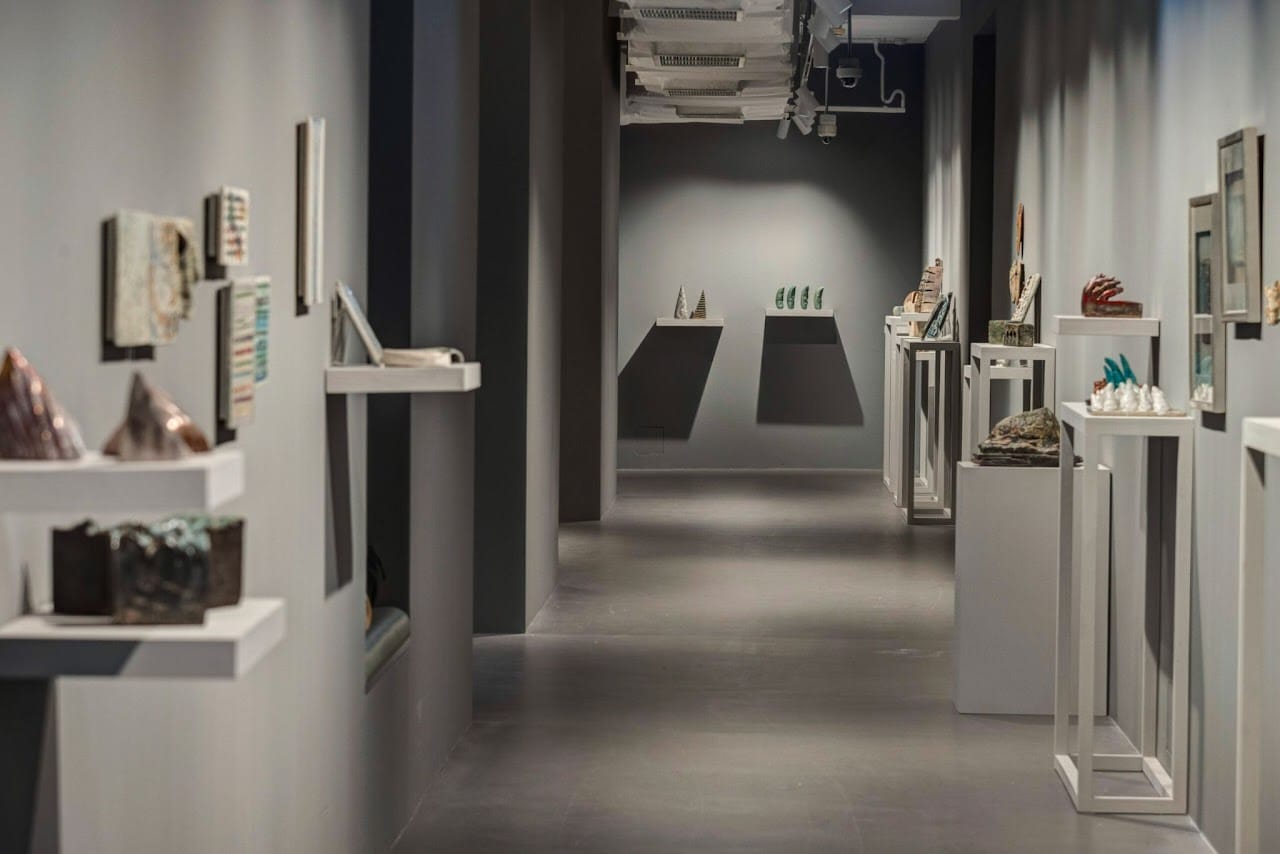
View of the exhibition (“The Search” room)
Part of the works in “The Search”, the first section of the show act like clues for “The Unknown”, the second part of the exhibition where they resolve the tension between meaning and the tactile presence of material engagement. They’re gathered by Ling Jia Le, the curator of the exhibition, in a single body as a puzzle. Displayed on shelves and plinths along the two-way corridor, there are studies, incipient pieces that furnish Delia’s universe, giving the space a certain intimacy and the sense of evolution. From sketches for large scale public works to studies of her grandmother’s lace and serial experiments with folding strips and masks, these works refer to knowledge and the effects of its presence in dialogue with clay and fire. From this point, the exhibition proceeds as an enactment of Being-in-the-world. The corridor does not simply display the artist’s process; it stages the disclosure of a world as lived and worked through—what Heidegger would call a worldhood, the complex web of references and material relations that make the works intelligible. Here, the mediums are not just substances she expresses her ideas through; they are what the philosopher names ready-to-hand—materials whose significance emerges from the very practices and histories in which they are embedded.
Viewed from this perspective, Delia’s practice reveals itself as more than a personal creative way of preserving an identity; it enacts a continuous negotiation with being-in-the-world, making visible the dynamic interplay between personal and collective memory and imagination. This corridor reaffirms that art is indispensable to the progress of humanity, for it nurtures the capacity to dwell and to remember. And that is yet another reason for which the museum that hosts this exhibition is becoming a meaningful part of it.
The fact that the passage is also used for exiting the exhibition makes it even more suggestive for the cyclicity of our existence, for the metaphoric return to roots, and the persistence in the act of search.
“I very much wanted to show something that could connect Southeast Asia with Venice.”
Delia Prvacki
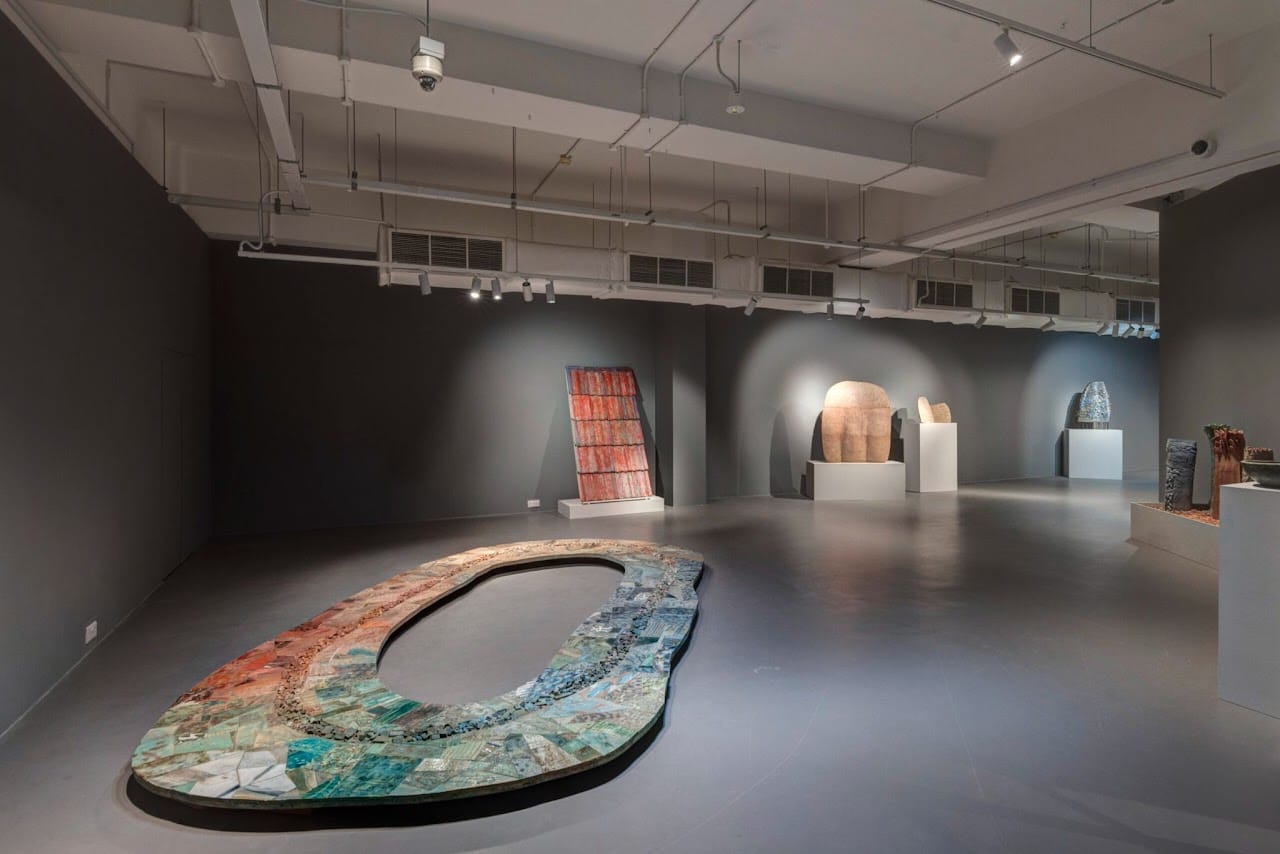
View of "The Unknown" room with The Silk Road, 410 x 220 x 4 cm 2007, Hand made glazed slab fixed on wood with oxide colored ceramic grog
Shifting towards the second chapter of the exhibition, an ample room reveals some of the artist’s most iconic works, pieces that have been part of major solo shows throughout the years, like “The Silk Road” which through its circular shape hints back at the dual path within the previous room. But besides holding onto this recurrent concept, the work is bringing yet another aspect of the exhibition to fore–the merging of two distant worlds, and the irrational particle that makes this circular form an infinite journey. And here is where I think it’s necessary to discuss what Delia Prvacki’s work is able to achieve in general and particularly with this exhibition–it manages to serve the matter and the spirit of at least two faraway identities. “The Silk Road” is where the ancient artery of exchange is reimagined as an endless loop: a stoneware path without beginning or end, where the shadows of caravanserais marked in ceramic grog are binding territories and times into a single continuum.
But these distances, no matter how connected they might become in her practice, are essential to understanding Delia Prvacki's practice. The material becomes a map of belonging as well as an instrument of transformation. At the same time, materiality is the one that brings us to what Jean-Hubert Martin so controversially proposed in the famous “Magiciens de la Terre”* exhibition in 1989 which can translate in this exhibition’s case into the cultural identity’s permeability to “other ways of life”.
“The notion of cultural identity” he said, “[...] is the product of a static concept of human activity, whereas culture is always the result of an ever-moving dynamic of exchanges. We might even go so far as to say that “acculturation does not exist.” I believe that art history's flow of thoughts and interests is somehow finding itself passing through a moment of re-examination of the artist’s agency–the exhibition becomes both a show of cultures and at the same time a universal exhibition of a subject. Much like Martin’s intention, Delia’s work foregrounds materials whose manual and alchemical qualities seem to embody a continuity with preindustrial worlds. Her sustained engagement with materiality might actually draw from the mineral substratum of her native mining town in Transylvania, a place that endowed her practice with an attentiveness to the ontological density of matter. How can But while Martin’s curatorial framing tended to fetishize such processes as vestiges of an “untouched” cultural integrity, Delia’s practice is far more complex than a metaphoric excavation: her use of clay is not an ethnographic gesture but a philosophical and poetic one, a way of literally thinking through matter.
The subtitle “Thinking through Clay” emphasizes process over product, reflection over display. Where the curatorial concept of “Magiciens de la Terre” often framed the “magician” as Other—a bearer of esoteric knowledge positioned outside modernity—Delia dislodges this binary. Her “otherness” is not an exotic projection but a lived experience, shaped by displacement from her Romanian heritage and by decades of life and work in Singapore. Rather than presenting clay as a cipher of arcane knowledge, she situates it within the everyday—an ancestral medium that still carries myth and memory, but one that also speaks to contemporary conditions of migration and belonging.
The works presented in the last room, “The Impulse”, turn these themes into a language of Being-in-the-world, a medium through which the impulse of creating opens a dialogue by inviting the viewer into the very act of thinking through material—transforming clay from an emblem of Otherness into a medium of shared world-making.
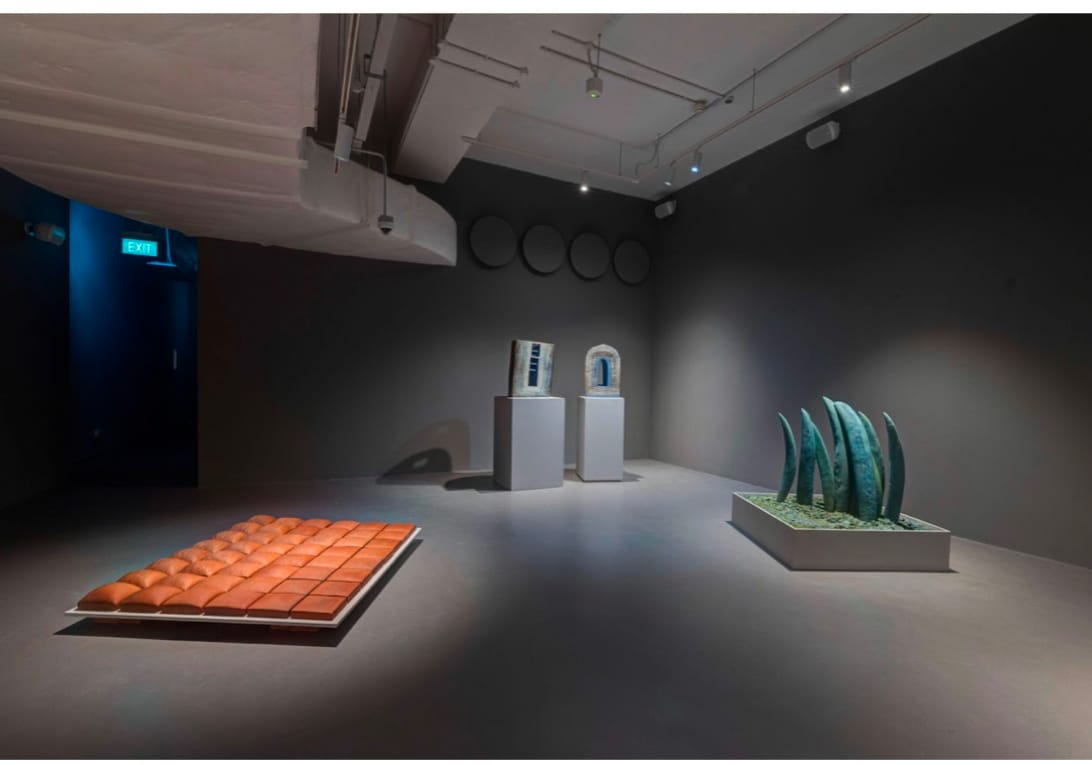
Exhibition view (“The Impulse” room)
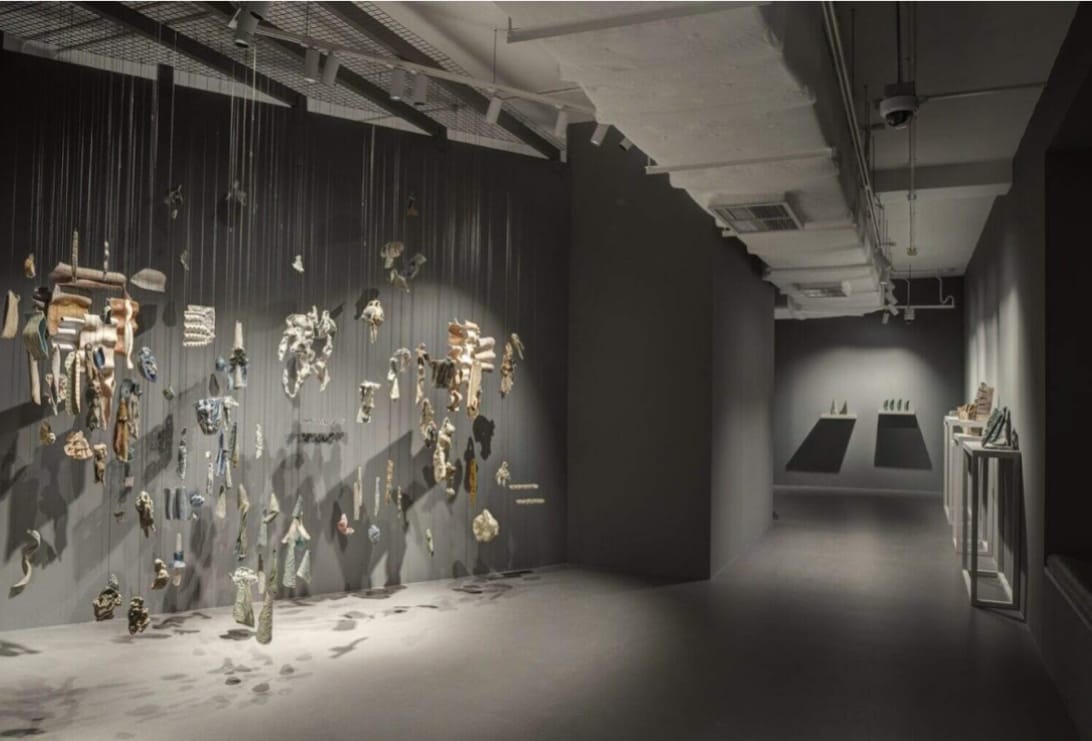
Spirits (2021-2024), porcelain, stoneware, glaze, and steel wire, dimensions variable.
“Spirits”, a central work in this section, addresses the role of participation as a defining element that differentiates ceremony-based practices from the Western aesthetic paradigm. In Eastern European spiritual contexts, artistic practice is inseparable from the life-world of its community; it operates as a unifying principle, a mode of relation that foregrounds interdependence rather than the individuation of a singular authorial voice. The site-specific installation of suspended porcelain creatures animates this being-with—a coexistence between ancestral motifs, mythic presences, and the viewer’s own position in the space. Hanging between earth and sky, these forms evoke a tension between groundedness and openness, echoing Heideggerian vision of human existence as poised between the immediacy of the material world and the openness of possibility, all enveloped in an unsettling playfulness here.
The hanging pieces, for instance, resist objecthood; they hover as liminal presences, drawing viewers into an encounter that is neither passive observation nor ritual reenactment, but something in-between—a hybrid form of participation that refuses the closure of categories.
It is in this refusal that "The Spirits" resonates with Homi Bhabha’s theorization of the “Third Space” as it inhabits a generative in-betweenness, a space of negotiation where ancestral Transylvanian imaginaries and Singaporean cultural realities interlace, producing new possibilities of meaning. In this space, heritage is neither fixed nor exoticized but continuously remade by the audience—a process of becoming that unsettles both essentialist identity and universalist aesthetics.
Leaving this work behind, the curator chooses to conclude the exhibition not with closure but with works in progress, refusing the fixity that retrospectives often impose. This refusal is not simply a curatorial choice; it states that the artistic process is always in a state of becoming—its meaning continually unfolding through its engagement with the world. In this sense, the exhibition is an artist’s portrait, a lived topography of that Being-in-the-world, where beginnings, middles, and endings dissolve into one another, carried forward by the current of an ongoing life’s work.
“Continuity, Persistence, Line”, on one hand, carries the intimate scale of personal memory—what might be called the emotional architecture of home. In the surfaces of clay and the dense ochres of pigment and glaze, there is a quiet persistence of mythic imagery, refracted through decades of life elsewhere. These are not nostalgic recreations, but living fragments of a self’s ongoing conversation with its origins. On the other hand, the exhibition presents only works created in Singapore, a city-state where heritage is deeply entangled with questions of national identity, cultural policy, and the politics of preservation. Delia’s sustained contribution to the country’s artistic life has made her a kind of national treasure—not in the static, commemorative sense, but as an active builder of heritage through her practice. Every work, installation, and experiment extends the archive of what Singaporean art can be, expanding the textures of its collective memory. In this light, the Singaporean cultural and artistic context plays a crucial role in repositioning Delia Prvacki's practice. Unlike other major solo exhibitions where artists were framed as figures surrounded by the mystifying aura of alterity, she emerges as a singular voice whose trajectory is deeply woven into the place she has inhabited for more than three decades. Her aura rests in the slow, deliberate act of carving a path in new territory—an aura born of persistence, of intimacy with matter, and of an unceasing dialogue between ancestral memory and present ground.
In this sense, she is not only an artist of heritage but a maker of it: shaping clay into language, into the connective tissue of belonging. Through this exhibition, Singapore, with its layered histories and dynamic cultural politics, recognizes in her practice the depth of an artist who has become both witness and builder of a collective inheritance.
The monumental ring that is "Gold Rush" stands at the entrance as well as at the exit, as a symbolic gateway, a metaphor for the eternal return, where every ending folds back into a beginning. Ultimately, Delia Prvacki's art does not conclude but continues to unfold—like a river that refuses to arrive, carrying minerals, myths, and intimations of home—an ever-unfinished offering that whispers of worlds still waiting to be revealed.
*